February 7, 2014

A Cold, Snowy, Rainy, Fun Weekend in Northeast Ohio

We haven't done much exploring in northeastern Ohio, so when friends suggested that we join them for the weekend at an inn near Chardon we readily agreed. They were hoping to spend time cross-country skiing, while we planned to do some hiking in area parks and preserves. Steady rain on Saturday meant that we ended up with a great group of 10 hikers and despite the weather all had a good time.

Our adventure began on Friday afternoon with a hike at The West Woods, a 900 acre park managed by the Geauga County Park District. We were quite impressed with their park system--many nice and varied nature preserves, a wonderful pocket-sized brochure for each park with an excellent trail map, and lovely nature centers. West Woods features hemlock groves and many large ledges of Sharon Conglomerate


that in one area make a formation called Ansel's Cave, which purportedly was used during the Civil War for munitions storage and to shelter runaway slaves.


Note that the icicles here go both up from the ground and down from the ceiling of the cave--icy stalgmites and stalactites! 

According to park signage, Sharon Conglomerate was deposited about 320 million years ago, but the sand and pebbles in it are 1.1 billion years old and their nearest source is in Canada. Some people call the rounded pebbles "lucky stones":


After our hike we warmed up in the nature center, which featured windows looking out onto a very active bird feeding area. Tree sparrows, mourning doves, white-throated sparrows, white-breasted nuthatches, downy, hairy and red-bellied woodpeckers and many more were feasting on the seeds and suet. Pretty soon along came a Virginia opossum to get in on the action, eating the seeds that had been dropped by the birds:


In addition to their cuteness, 'possums are interesting mammals that we don't see very often except as roadkill. They are mainly nocturnal but obviously can also be active during the day, and they are the only native North American marsupial. They don't hibernate so even in a cold winter they have to find food whenever and wherever they can. Their coats are relatively thin, and their feet, nose and ears are bare, making them quite vulnerable to frostbite. Although they don't live much longer than two years, they are able to make it through the winter by storing fat in their tail and under their skin. Love those pink feet!

Saturday was pretty much all about hiking in the rain (and having a really good lunch and dinner). We visited two preserves, Big Creek and Penetentiary Glen. We loved the hemlock groves and a tiny frozen waterfall


and had a laugh at this sign:


While we didn't see many animals, evidence of wildlife was all around us including tracks in the snow and these pileated woodpecker holes:


These huge birds drill into tree trunks to get to carpenter ants, among other insects. 

Sunday we woke up to steady snow and falling temperatures. Our friends headed for some skiing while we drove west to Cleveland to meet Jen Brumfield, one of Ohio's most experienced, fun, and informative birders, who was scheduled to lead a walk along the lakefront. We hadn't been to this area in many years so we were pleased to have the opportunity to check it out; it is typically one of the most productive and exciting winter birding areas in the state. Extremely uncomfortable weather typically adds to the "excitement", with snow, ice, and wind creating pretty miserable conditions. Fortunately, this time we just had 2 out of 3 since the wind was pretty quiet.

This is the scene that greeted us at our first stop, a park at the end of East 72nd Street:


Wherever there is open water along the Lake Erie shore, ducks from the north tend to congregate in large numbers. Often they are accompanied by huge number of gulls, and sometimes very rare ones can be found among the ring-billed and herring gulls. In a cold winter like this one, open water near the shore is hard to find, except where a power plant discharges the warm water that has cooled its turbines. This is the power plant that provides the discharge at this spot; an added benefit of it was that it is a favored perch of peregrine falcons and we were fortunate to see one!


While we didn't see any rare gulls, we did see a lot of ducks, including all three North American merganser species. Here is the male hooded merganser with a female red-breasted merganser,


the spiffy male red-breasted merganser


and the elegant common merganser with a female of the same species.


Notice how their bills are hooked, and if you could see the bill close up you'd see that it has tiny teeth or serrations, characteristics that are quite helpful for catching fish. They were joined by mallards, both lesser and greater scaup, and these redheads that are in the foreground:


At another spot along the lake, but beyond photography range, were huge numbers of canvasbacks and some common goldeneyes. As we were scoping these ducks a gorgeous adult bald eagle flew by. 

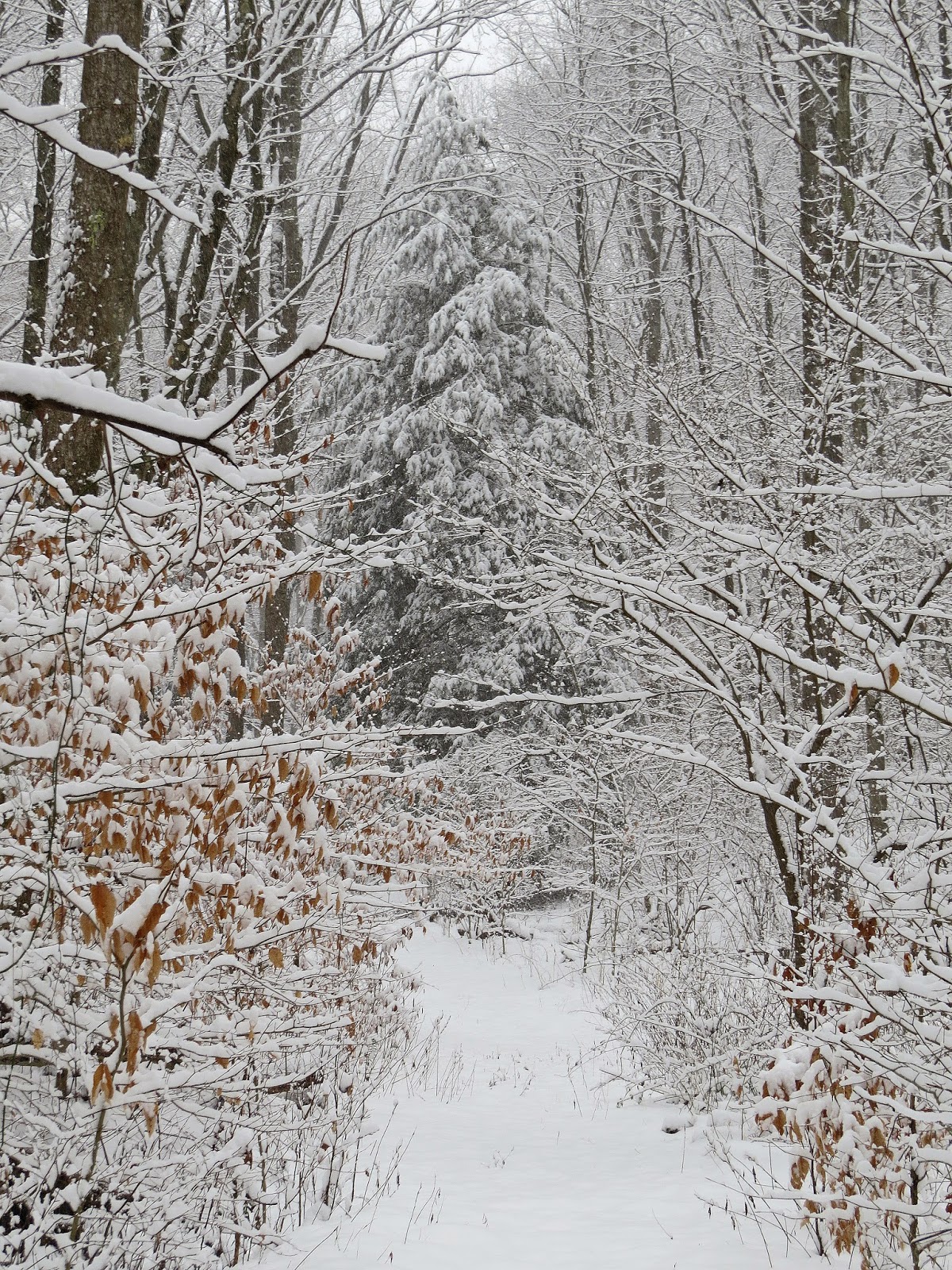
With dropping temperatures and increasing ice formation we were ready after a couple of hours to head south to central Ohio. Although the weekend weather was uncomfortable at times and we never saw the sun (obvious from these pictures!), we were well-prepared and able to enjoy beautiful winter scenes like this:


January 28, 2014

Snow Rollers!

This fun phenomenon has been widely covered by local media and is the subject of many Facebook photos but I thought that out-of-towners might enjoy seeing what is entertaining us here in central Ohio as we deal with the polar vortex and the -11 degree temperature that we woke up to this morning!

Extreme cold temperatures, a couple of significant snowfalls, and strong winds have combined to make recent weather the major topic of conversation in central Ohio. Schools have closed, trash collection has been delayed, and many events have been rescheduled. It has, however, also brought delight: sunshine and some of the strangest and most surreal landscapes I've ever seen:


What are those weird clumps of snow that have appeared on local lawns and open spaces and look like bathroom tissue rolls that have arrived from outer space? Several people posted photos of them on Facebook and one friend identified them as "snow rollers". I had never heard of such a thing!

Venturing out, I saw lawns full of them and they were especially impressive on the nearby golf course and parks. Here is a close-up, with back-lighting to show the translucent center:


These rolls are not hollow--I split one open to see what it looked like:


You can see that the center is solid, since these rollers start out as small balls and pick up both thickness and length as they roll over the snow. (In some cases the centers are weak and blow out in the wind, leaving a hollow cylinder but all the ones I looked at still had a core) Think of snowmen you have made--you have to keep turning the ball in order to make the whole thing solid and round. Otherwise you would have a cylinder with a solid core and more hollow sides, just like in the snow rollers.

Wikipedia describes these rollers as a "rare meteorological phenomenon". I've seen references to them occurring this week in Illinois, Ohio and Pennsylvania, all areas that have shared some pretty unusual weather over the past several days.

In order for snow rollers to appear, a thin layer of ice has to form which is then covered by new snow that is around ice's melting point. Then if high winds blow over the landscape they can, so to speak, start the balls rolling and if the wind is strong enough but not too strong, snow rollers form. Here are a couple of photos showing the tracks of the rollers:


Here are some that didn't make it to cylinder size:


It looked like the tracks of most that I saw had been obliterated by the wind. In fact, the wind scoured the snow around many of them:


When you get to be my age you think you've heard of just about everything that weather can dish out, and then something like this comes along and you realize that maybe there will always be surprises in store, and some of them might even be fun. (Hmmm--I had similar thoughts about a rare meteorological phenomenon that I had never heard of a couple of years ago but it definitely wasn't fun--the derecho of 2012!)

Update 1/29/14:

We couldn't resist taking more pictures! 


Today we saw a few that were hollow, likely because the initial core was weak and blown out by the wind.

January 26, 2014

A Winter Walk in the Park

A couple of blocks from our house, but separated from us by a busy state highway, is the large body of water known as Griggs Reservoir. The dam that forms the reservoir on the Scioto River (pronounced SY-oto for you out-of-towners) is just a couple of miles downstream and recently we heard that some interesting ducks and other waterfowl had been seen below the dam. So, when it finally stopped snowing this morning, and the driveway had been shoveled, we headed for the river.

One look at the dam had us wondering what bird in its right mind would want to paddle around in the freezing water


but then that thought was overtaken by hoping for something really cool, like a Harlequin Duck that would have been right at home in the turbulent water. We didn't have any luck with the Harlequin, but as we walked south along the river we weren't disappointed with the waterfowl that were mixed in with the legions of Canada Geese and Mallards.

This pair of Common Goldeneyes was an exciting sight because they are among the less common of our wintering ducks here in central Ohio. As we looked more closely, we saw at least a dozen of these beautiful birds. 


Check out these Ring-necked Ducks--one of my favorites. We always say that they should be called Ring-Billed Ducks, but there actually is a ring of cinnamon color around their necks, visible only in perfect light. The second duck from the left is a female Common Goldeneye. 


Over a dozen Hooded Mergansers swam and dove in the fast-moving water. The snazzy males are spectacular but I've always liked the pert cinnamon crest on the females too:


It was fun to see this winter-plumaged Horned Grebe on the far side of the river. Very hard to photograph, it kept diving and coming up in unexpected places!


We were also treated to views of a few sleeping scaup, a spectacular look at a Belted Kingfisher, and a decent look at a far-off Black Duck. We weren't the only folks out at the river today; we saw 2 other birders, 3 frisbee-golfers, a dog-walker and...well, I'm not sure what you would call it but this fellow said he was having a lot of fun!


I'm not a huge fan of winter but the season certainly shows off the beauty of the magnificent sycamore trees that line the river.


A snowy walk along the river turned out to be a great way to spend the afternoon!

UPDATE: My daughter in Colorado informed me that the fellow in the picture is practicing "slacklining" which is quite popular where she lives in Boulder. According to Wikipedia there are many styles of the sport, as well as competitions. It does look like fun, especially if you can fall into deep snow and not directly on the ground!

January 7, 2014

A Florida White Lily Trifecta

For the past couple of years Bill and I have done a road trip in early December to Florida. It is always a bit strange to us to see palm trees decorated with Christmas lights, and to hear Muzak featuring "Let it Snow" when it is over 85 degrees outside. But it is always a fun trip and this year was no exception.

December isn't the best time of year for wildflowers but we did manage to see a fair number. Three beautiful white lilies were especially memorable. 

The first is called the Atamasco Lily (Zephyranthes atamasca). It is mostly a early spring bloomer in northern Florida, but we spotted a few on this December trip:


The bulb of this plant contains alkloids and a toxic chemical called lycorine, so eating it is definitely not recommended; some references indicate that all parts of the plant are poisonous. The plant prefers moist soils and can grow well in roadside ditches, which is where we saw them. 

The state of Florida lists the Atamasco Lily as threatened due to habitat loss. It often grows in clumps, and when the sun is out and the petals broadly flare it really is beautiful.

The next white lily grows along swamp or pond margins and is aptly named Swamp Lily (Crinum americanum). Its flowers are quite fragrant and they are huge--roughly 6-7 inches in diameter:


The plant rises from a large, 3-4 inch bulb and its straplike leaves can be up to 3 feet long. Despite the fact that all parts of this lily contain poisonous alkaloids, it is always fun to see its gorgeous flower!

Last but not least is the Spider Lily (Hymenocallis crassifolia). The membranes between the upright stamens make it quite showy:


It, too, arises from an alkaloid-containing bulb and is found into Louisiana and the Carolinas in addition to Florida.  Like the other lilies mentioned here, it prefers moist soil and can be found in wetlands and along creek and river banks.

Beautiful flowers, poisonous bulbs--nature doing its best to attract pollinators and repel predators! 

January 4, 2014

A Tale of Three Hairstreaks

One of our objectives on our recent trip to Florida was to try to expand our Florida butterfly list. December isn't the greatest time to do that, but we figured we'd at least give it a try, and we were actually pretty successful. 

We were especially hoping to see some hairstreaks, butterflies that are usually have hair-like projections on their hindwings that look almost like antennae and are probably designed to make both ends of the insect look like its head. Predators are often fooled into grabbing the wrong end, and the prey flies off with just some tattered hindwings. Most hairstreaks are pretty tiny, and you have to get binoculars on them to tell what they are and to appreciate their beauty. 

One of the hairstreaks that we especially wanted to see is atypical in that it doesn't have the hindwing projections; taxonomists have included it in the group anyway. This insect is called the Atala, and is one of the rarest butterflies in North America. 

At one time it was fairly common, because its larval food plant, the coontie (Zamia integrifolia), was common in the pine flatwoods of Florida. Beginning with the native Americans, however, coontie was harvested for the starch in its large tuberous roots. By the early 1900s, several industrial facilities were harvesting the plant, particularly to make arrowroot biscuits.

Coontie is a cycad, and some people have described it as a "living fossil" since cycads are pretty rare in the western hemisphere north of the tropics today but were quite common in Jurassic times. Coontie is dioecious, meaning that it has separate male and female plants. Here is a picture of the cones on the male plant:


and here is the female plant.


Once the cone on the female plant matures it crumbles and bright orange seeds are revealed.


With the harvesting of so much coontie, the Atala butterfly was thought to be extinct in Florida. Recently, coontie has been recognized as a valuable landscape plant and is appearing in south Florida gardens. Atala caterpillars have been introduced in some areas, and populations have begun to grow where there is plenty of coontie. 

When we were planning our trip, we called around to several nature centers that have butterfly gardens to see if they had any Atalas, and a couple of them sounded promising. First we went to Gumbo Limbo Nature Center, near Boca Raton, which is within Red Reef Park. The beach part of the park was stunning and uncrowded early in the morning:


We weren't disappointed by the butterfly garden at all. Wandering through the paths, we found at least a dozen Atalas in all their gorgeousness. This has to be one of the most beautiful insects around, with its "starry night" wings, orange abdomen and adorable face!


We even found one that had just emerged from its chrysalis, and was still pumping fluid from its abdomen to its wings:


The other place that we saw it was Daggerwing Nature Center, west of Boca Raton. At both of these butterfly gardens the Atalas were there naturally and were not introduced. 

After that excitement we poked around many other beaches and preserves and then headed north to the Titusville area. All along the way we had been reading signs about a very invasive plant, the Brazilian pepper, that is choking out native vegetation. It forms dense thickets, and efforts to eradicate it are extremely labor intensive. It is native to Argentina, Paraguay, and Brazil, and was introduced to Florida as an ornamental.

We talked to some biologists in the Everglades who told us how hundreds of acres had to be scraped down to the bedrock to get rid of the plant, and then the debris was piled into a large hill that we hiked up a couple of years ago! Interestingly, the hill now supports a variety of wildflowers and butterflies. It is attractive, and like Ohio's nemesis, the honeysuckle, many people like the fact that it provides a screen. It is very bad for native wildlife though! Here is a photo of it--we saw dense patches of it all over Florida and it apparently is spreading northward:


Anyway, as we were checking out a natural area near Titusville, we noticed a small hairstreak butterfly, nectaring on a passion flower. It was unfamiliar to us and to the friend we were with, who is quite knowledgeable about Florida butterflies:


I went back to the car and got my field guide and pretty quickly matched my photo up with a picture of the Fulvous Hairstreak (fulvous means reddish). Looking further at the field guide entry, I saw that its caterpillar food plant is none other than the Brazilian pepper, which formed a dense hedge behind where the butterfly was nectaring! The field guide showed its range to be quite a bit south of where we were, but with the spread of the peppers the butterflies seem to be extending their range as well. In fact, our friend was going to check to see if this was a new county record.

A third hairstreak from this trip was memorable because the instant we got our binoculars on it we recognized it from home: the Red-banded Hairstreak:


Here is a picture of another individual that shows the hindwings a bit better:


This lovely insect is near the northern edge of its range in Ohio; we have seen it at Clear Creek Metro Park. It is, however, more common in the southeast. The females lay eggs on the leaf litter beneath the caterpillar food plant, usually wax myrtle (in the south), sumac and oaks. The caterpillars actually feed on the fallen leaves.

So there are three of the more interesting butterflies that we saw, and each has its own unique story. But in each case, their range is dependent on the presence of specific caterpillar food plants.


January 3, 2014

Maybe Winter isn't all THAT Bad...

Yesterday Bill and I ventured out to Clear Creek Metro Park in the Hocking Hills to meet three friends for a day of hiking. We were a little reticent, since there was a snow advisory when we left home and there was already an inch or so of new snow on the ground. By the time we got to Lancaster the snow was coming down pretty hard so I checked my weather app. Oops--while we were on the road the snow advisory had turned into a winter storm warning, and the snow accumulation prediction had gone from 1-3 inches to 3-5 inches. Well, we were already nearly there so it didn't make any sense to turn back, and we were glad we didn't!

The hiking was really fun. The forest was surprisingly quiet, with no birdsong or rustling leaves. The snow even muffled the sound of our footsteps. I enjoyed getting out in front and traipsing through the new, untracked snow. 


Since the snow was so fresh, we didn't see too many animal tracks but I'm sure that by now there are plenty. Animals tend to hunker down until the storm passes, and often you can then observe a lot of activity.

At one point our friend Jim was hiking behind Bill


and noticed something move in the footprint Bill had just made. He called the rest of us over, and asked us to hand him a walking stick. He flipped over the crust of snow that Bill's boot had made as he walked ahead, and there was a tiny, dark gray mammal--a short-tailed shrew! Unfortunately I wasn't fast enough to get a picture; quite rapidly the shrew scrambled back into the snow and disappeared.

Short-tailed shrews are voracious predators and have to eat about 3 times their weight in insects, worms, snails and other animals each day in order to survive. They do not hibernate and can also eat plant material and fungi. They are one of the few mammals that has venom glands, which secrete a neurotoxin to subdue their prey. We seldom see them so it was great fun to see this little guy, especially against the snow cover.

Later in the hike we came across this beautiful lake, surrounded by hemlock trees:


I loved seeing the snow-covered beech trees, with their leaves still clinging to the twigs:


Clear Creek certainly looked different than just a couple of months ago!


The fruits of a sourwood tree look especially elegant with some snow cover:


Last summer's ironweed stands tall in a meadow:


It was definitely worth venturing out yesterday for this snowy adventure!


December 21, 2013

Late Fall at Buzzards Roost

Back in November we did another good winter hike in an area that was completely new to us. This was the 1300-acre Earl H. Barnhart Buzzards Roost Nature Preserve in Ross County near Chillicothe. This hike was particularly interesting to me since I went to high school in Chillicothe and had no idea that this natural area was so close. That, of course, was a very long time ago and it was private property then but I've remained unfamiliar with it until just a few weeks ago.

The Paint Creek Gorge is at the heart of this preserve, and the surrounding cliffs are quite dramatic:


Here is a view of Paint Creek in the valley below:


We hiked two trails at the preserve, starting with the South Point Lookout trail. It took us by an abandoned cabin; I loved playing in an old cabin in the woods behind our house when I was a child in Pennsylvania so I always take note of structures like this:


The area is known for its spring wildflowers, which of course were long gone by the time we visited. We saw hints of what is to come, though, including leaves of the cranefly orchid


and the puttyroot orchid.


Here is a spot where a buck scraped the ground to indicate its territory:


After lunch we went back to the preserve and did its other hike, the Hoggard Trail. We were fortunate to be accompanied by Joe Letsche, who is the naturalist at Buzzard's Roost. He is also a herpetologist and quite knowledgeable about animal tracks so it was great fun to hear what he had to say. We hiked back to a small pool that in the past has hosted marbled salamanders, one of the most attractive of Ohio's amphibians.

Readers might remember a post about several of Ohio's salamanders in early April. Those animals tend to do their courtship, mating and egg laying in the very early spring, in what are called vernal pools. These pools dry in the summer and fit the salamanders' needs because they don't support fish that would prey on their young.

Black with intricate white markings, the marbled salamander is an exception to that pattern. These animals breed in the fall, generally not in, but near vernal pools. The eggs are laid in a spot that will soon be inundated and the larvae overwinter in the pond and become adults in the spring. Meanwhile, after breeding the adults find shelter for the winter, generally in an old mouse burrow or other protected place.

So on our hike, we arrived at the woodland pool


and Joe used a net to explore the leaf litter in the pool to see if he could find any salamander larvae. It didn't take long! Clearly this was a very active marbled salamander breeding location. Here is one of the larvae, which was about an inch long:


This salamander is uncommon and its populations are widely scattered throughout the state. Most people, even those who spend a lot of time outdoors, have never seen it so it was great fun to get to see even its larval form.

Joe spent some time looking for any adults that might still be hanging around the pool, but didn't find any.


For more information about Buzzard's Roost and photos of it during the summer, check out the TrekOhio post here.