November 26, 2012

Leave it to Beavers


I've found that usually when we go out exploring, no matter how much we've tried to find out about our destination beforehand, there is usually at least one surprise in store for us. Here is the unexpected sight that we came upon recently at Kiser Lake Wetlands State Nature Preserve:
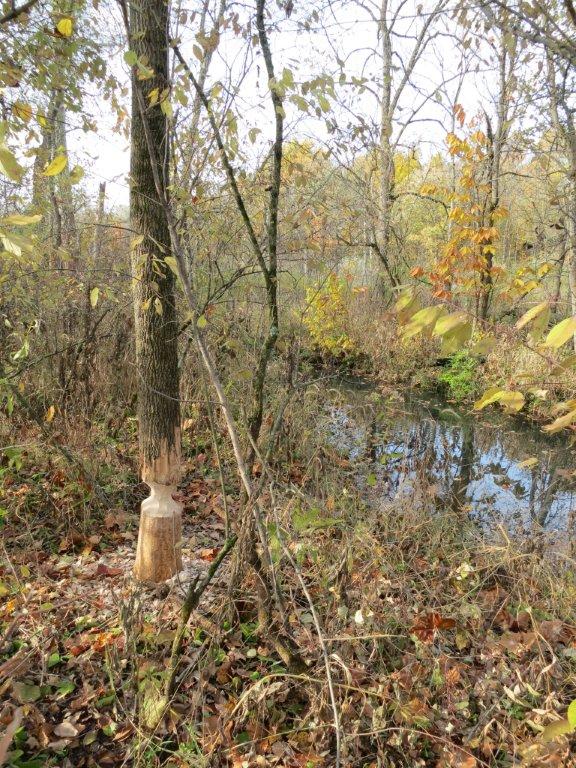


Of course I had to get a closer look!


Clearly, this was the work of a North American Beaver (Castor canadensis), and it looked like that work was quite recent. I have seen lots of beaver evidence in my years of hiking and working outdoors, but never have I seen a freshly-gnawed half-felled tree, looking as precarious as this one was! I was tempted to see what would happen if I pushed it, but I resisted.

These large semi-aquatic nocturnal rodents eat tree bark and the cambium layer just under the bark. Obviously, this individual stripped the tree all the way down to the structural wood, as far up as it could reach, and then starting to gnaw into the wood to take down the tree. They also eat a variety of aquatic vegetation.

An even closer look reveals the beaver's tooth marks:


Work like this is likely to wear down the strongest of teeth; fortunately the beaver's strong incisors continue to grow throughout its life.

This seemed like a pretty big tree for a beaver to deal with, especially since the nearby stream was small and not flowing very rapidly. I didn't see any evidence of beaver dams nearby so I don't know what this tree's destination might be.

Beavers were extirpated in Ohio by 1830 after trapping by both Native Americans and settlers who sold the pelts for use in tall beaver felt hats, which were all the rage in England. The heaviest trapping occurred between 1750 and 1800. 

About 100 years later, beavers were again active in Ohio. Now, although seldom seen, they are quite common and often wreak havoc with culverts and flood control facilities. Their dam building also increases wildlife diversity and continuously changes the landscape in natural areas.

Since I've gotten kind of interested in Pleistocene mammals since I started doing this blog it is interesting to note that the North American Beaver that we are familiar with is not the first beaver species known to live in Ohio. That honor would have to go to the Giant Beaver (Castoroides ohioensis), which became extinct only 10,000 years ago. This animal was 7 1/2 feet long and weighed 400 pounds! In Ohio it ranged from the western border east to the Columbus area. What a different place this must have been!

For more beaver information and a cool video, check Jim McCormac's recent post over at Ohio Birds and Biodiversity.

Kaiser Lake Wetlands State Nature Preserve is well worth a visit with its boardwalk that allows access to an alkaline fen and marsh, rare habitats in this area. Here is a picture of Stiff Gentian (Gentiana quinquefolia), a lovely late-fall wildflower that often blooms into November:


November 18, 2012

A Bittersweet Tale

Even after most of the leaves have fallen from the trees, late fall has a lot to offer in the way of color and interest. Recently we noticed these bright berries on a walk in a nearby park:


I recognized them as the fruit of a woody vine called bittersweet, which is often used in fall wreaths and other decorations. I hope that this particular plant is American Bittersweet, Celastrus scandens, but I suspect that this plant is its extremely nasty cousin called Oriental Bittersweet, C. orbiculatis. Without leaves they are hard to tell apart on a small plant, but the oriental variety tends to have fruit all along the twigs rather than just at the tips. 

What's so nasty about Oriental Bittersweet? It is one of North American's most invasive plants. Its seeds are readily spread by birds, and their germination rate is very high. The plant grows rapidly and can engulf large trees, out-competing them for sunlight. The really menacing thing about these vines is that they can grow up to 4 inches in diameter and can literally strangle a large tree by compressing its vascular system and preventing the flow of water and nutrients, much like the tropical strangler figs. Here is a picture of the plant that we saw, showing a small woody vine climbing in a twisting fashion up a shrub:


Imagine a 4 inch vine doing the same to a large tree! 

A few days later we were taking a walk in another park and spotted something I'd never seen before: a small tree with what looked like bright pink berries:


I knew it wasn't familiar so I had to take a closer look:


Getting even closer, I saw that the fruit was actually red with a pink covering, and it certainly had a structure similar to the bittersweet we had seen a couple of days before:


A bit of googling and checking in some books soon revealed the plant to be a small tree or shrub called American Wahoo (Euonymus atropurpureus). It too has an invasive cousin, E. alatus, which is the common landscape plant known as burningbush

According to Horticulture Magazine, American Wahoo is an excellent choice to replace E. alatus in the home landscape. "Once the foliage drops, the red fruits inside light pink capsules will stop traffic." It certainly stopped me! It is native to the eastern half of North America, and is generally found along streambanks but can do well elsewhere also. American Indians believed it to have a "warrior spirit" and planted it around their camps to keep enemies out.

So back to the fact that both bittersweet and American Wahoo have bright fruits which are revealed with the opening of a colorful capsule. Well, a bit more research reveals that both plants are members of the botanical family called Celastraceae, or the bittersweet family. Most of the genera within this family are tropical, with Euonymus, Celastrus, and one other being the only ones to grow in temperate areas.

Both American Bittersweet and American Wahoo are interesting plants to find when hiking in late fall. Both can be fun additions to the home landscape as well. Just be sure to avoid the nasty relatives! (Always good advice as Thanksgiving approaches...)

November 11, 2012

Big Darby Headwaters Nature Preserve


I have probably spent literally hundreds of hours with students of all ages in Big Darby Creek, studying stream ecology and just plain having fun. Oh—and I’ve had some wonderful kayaking and canoeing adventures too.


Big Darby Creek in central Ohio has been designated as both a State and National Scenic River, because of the diversity of plants and animals that live on, in, under and around it. The raccoons in the photo below (you might have to squint to see them) may not know it, but the creek also is one of The Nature Conservancy’s Last Great Places, so designated because healthy streams of this type, that originate as cold water seeps, are very rare in North America.


Big Darby, and its main tributary Little Darby Creek, run for 82 miles through several Ohio counties and drain a watershed of over 500 square miles. For much of their distance the creeks are lined with mature forests which keep agricultural and other pollutants out of the stream and feed the system with the leaves that drop each fall. 


Development pressure, farming, bridge and highway construction, and other disturbances have, however, threatened portions of the stream and require continuous monitoring.

The creeks support nearly 100 different species of fish, some endangered, and 44 species of mussels, which is truly remarkable. Some of my favorite Darby Creek experiences involved noodling around for different kinds of mussels, and one awesome day watching representatives of the Ohio Environmental Protection Agency employ a method of stunning fish to examine their condition and to inventory species.

But recently I had a different Darby Creek experience when we visited the new Big Darby Headwaters Nature Preserve just northwest of Marysville. This land not only preserves upper reaches of the creek's watershed, but it is also the site of an extensive stream restoration project. A segment of the stream that had been turned into a man-made channel along a highway has been transformed into a much more natural meandering configuration by a project sponsored by The Nature Conservancy. This new stream mimics the natural flow of the stream from its beginnings as a series of seeps and wetlands, and already has resulted in increased wildlife diversity in the area.


For the whole story, try to plan a visit to this preserve. Excellent interpretive signs introduce the creek and the restoration project. The 2.5 mile (round trip) trail is a wonderful hike of minimal difficulty through forests and abandoned farm fields which, when we visited, were lovely with goldenrod and purple New England Aster. 


This project will go a long way toward ensuring that the Darby continues to support diverse plant and animal populations and that it continues to provide excellent educational and recreation opportunities. I can't wait to get back into the creek!


November 4, 2012

Botanical Hitchhikers

Those of us who grew up roaming woods and meadows can remember often coming home with a variety of hitchhiking seeds attached to our clothing:


Kids that I hung around with called all of them "burs" but we had no idea what the parent plants looked like, since we didn't realize that they had hooked on to us till we were far away and had started picking them off, preferably before going into the house. 

That, of course, served the plants' interests extremely well, since our actions helped to spread their range, avoiding competition with the parent and other plants in their immediate area.

Recently I've started to learn to identify more plants and in the process have found out, in some cases for the first time, where some of these "burs" come from.

At the top of the sock are the hooked burdock burs which are supposedly the inspiration for Velcro®. Each bur contains the small seeds shown in the lower right: 

There are several species of burdock, all native to the old world and widely distributed. The plant's enormous leaves make it nearly unmistakable:


Here is a picture of burdock in bloom:


Next are some of the most common burs, from a plant called agrimony (accent on the second syllable) or groovebur. 


There are 7 species of agrimony that are native to North America and the plant is reported to have a variety of medicinal uses. A member of the rose family, it has small yellow flowers and compound leaves. Here is a picture of the plant showing the flower stalk bearing the burs after blooming:


Here is a close-up view, and notice how the burs are angled down, the better to snag on a passing mammal: 


Next is cocklebur, a member of the aster family.


It is found mostly along streams and in wet areas. Each football-shaped cocklebur fruit contains two seeds. 


It has large coarse leaves like burdock, but in general the plant is much smaller.

Last but not least are the seeds of beggarticks or sticktights.


These come from plants in the genus Bidens and have a wide variety of common names. There are about 200 species of Bidens, and they occur all over the world. Some common members of the genus are not at all showy, with no petals or ray flowers:


Another one in this area is the very showy Nodding Bur Marigold, generally a plant of wet areas:


If you have ever had to cut any of these burs out of your dog's hair or tried to pick one out of your carpet you can really appreciate their tenacity. Plants whose seeds stick to clothing, fur or feathers are termed zoochorous and they have managed to exploit this characteristic to spread all over the world. 

A few posts back I wrote about the huge Pleistocene mammals that roamed Ohio just 13,000 years ago, and postulated that they probably had lice and fleas. Just think about what else they were carrying around in all that fur!


October 28, 2012

Big Trees and Small Parasites


Johnson Woods is a state nature preserve in northeast Ohio that features over 200 acres of old growth forest. On a recent visit we walked among its giant trees on a 1-mile boardwalk, marveling at the huge oaks, hickories, maples and other trees. Many of Johnson Woods' trees are over 400 years old and some reach 120 feet in height.


Here is a Black Gum (Nyssa sylvatica) that added a bit of spicy October color to the green canopy.


Gradually the dominant oaks and hickories are giving way to maples and beech. The American Beech (Fagus grandifolia) is a magnificent tree and I've never seen so many huge ones. It is one of my favorites partly because it is so easy to identify, thanks to its smooth bark:


Most beech trees next to a trail have been decorated in various ways:


Since trees grow in height from the top, Aaron and Marie have only become wider in the past 11 years (they are not alone), and will remain at eye level for the life of the tree.

Beech leaves are simple, slightly toothed, and alternate along the twig. The characteristic sharply pointed buds make winter identification very easy.


Fall color can be quite striking:


I really like the way young beeches retain their leaves into the winter, giving a delicate accent to a view through a forest:


The beech’s seeds are contained in these prickly husks. Each husk has seeds which fit neatly together until the husk dries, opens, and releases the edible seeds or beechnuts. 


Apparently beechnuts have little to do with Beech-Nut gum or baby food. The company was named for the beech trees that grew near the town in New York where it was founded, but the "nut" part comes from the nutty-flavored hams that were its first product.

One of the coolest things about beech trees are the Beechdrops (Epifagus virginiana) that often grow beneath them. These small plants produce no chlorophyll, gaining all their nutrition from the roots of American Beech, thus qualifying as parasites. Without the trees they could not survive.


The Johnson Woods beeches supported the greatest Beechdrop density and largest individual plants that I have ever seen. 


Parasitic plants have modified roots that penetrate the host's vascular tissue, but how does the seed of a parasitic plant know that it is near its host, and how do the developing roots find the host plant? Apparently the host plant exudes chemical signals that are recognized by the seed and that stimulate germination. The developing plant's roots then follow a chemical concentration gradient toward the host. Pretty amazing. 

I have a feeling that I'll be repeating that phrase often in this blog. It is fascinating to consider that despite the fact that plants are immobile, they are able to successfully reproduce, protect themselves, get nutrition, and grow. There is a whole lot going on in the plant world, and we probably don't have a clue about much of it.

Something else to ponder: what are the chances that T.S. still loves L.M.?


October 19, 2012

Fall Leaves


Lately a couple of people have remarked to me that the fall color this year is disappointing and speculated that this might be because of the summer drought and high temperatures. Personally, I think the color this year has been just fine, and in some cases, spectacular. I suppose it just depends on where you are, and fortunately we have been exploring in places where the color has been lovely.


I have a major job ahead raking lots of those lovely leaves, some perhaps for the second time thanks to the high winds we had over the weekend. Just as I was contemplating that chore yesterday I happened to see a beautifully written and illustrated essay by Rob Dunn in the October 2012 issue of National Geographic entitled "The Glory of Leaves".

The article delves into the evolution of leaves from the beginning, when a cyanobacterium entered a living cell and began to capture energy from the sun, giving rise to the amazing and varied world of plants. It muses about how natural selection has produced such a variety of leaf shapes and sizes, all contributing to intense competition for sunlight. 


In most cases we can't begin to imagine the selective advantage one leaf type might have over another in a temperate deciduous forest, whether they are rough, smooth, toothed, lobed, simple, compound, or a host of other descriptive attributes.


And why would leaves with different shapes occur on the same tree, as in sassafras and mulberry? What selective advantage might this characteristic, called polymorphism, offer to the plant?


The relationship between the shape and texture of leaves and their function is a fascinating topic for discussion but few definitive answers are available. The constantly changing mix of climate, competition for water and nutrients, and the need for defense mechanisms ensures that natural selection will continue and the plants upon which it acts will continue to slowly change in response.


So much is going on all the time in the plant world, most of it quite subtle by our standards, and that will give me lots to think about as I rake all these fallen leaves!


October 14, 2012

Glorious Goldenrod


Goldenrod is one of our most striking fall wildflowers but it often gets a bad rap as the cause of hay fever and other allergies. The true fall allergy culprits are the ragweeds,  which have quite inconspicuous flowers.

The reason that ragweeds cause such a problem is that each plant depends on the wind to distribute its pollen. This is a random process which requires that the plant use its energy to produce A LOT of pollen in order to ensure that a few of the microscopic grains fall on a receptive plant of the same species. Goldenrod, on the other hand, is pollinated by insects, which is a much more targeted strategy, requires far less pollen, and releases little or no pollen to the air. It does, however, require the plant to use its energy to produce flowers that can attract insects via color, shape, aroma, and nectar.  Neither strategy is necessarily better than the other; they are just different means to the same end.

This fall I’ve put a bit of effort into learning to identify some of Ohio’s 22 species of goldenrods, and I have a long way to go. The most common species is the Canada Goldenrod (Solidago canadensis), which turns meadows bright yellow in the fall.


It has a large, triangular plume of flowers at the top of the flower stalk, and its nectar attracts and feeds myriad insects:


Stiff Goldenrod (S. rigida) is a prairie plant that can be found in restored prairies at Battelle Darby Metro Park and many other locations in central Ohio. Its thick leaves that seem to clasp the stem make it easy to identify.


 Gray Goldenrod (S. nemoralis) is usually smaller than Canada Goldenrod and occurs in prairies and disturbed areas such as freeway rights of way. Its inflorescence is at the top of the stem but it is narrow and bends a bit at the tip.


Zigzag Goldenrod (S. flexicaulis) is different in that its blooms occur all along the stem at the leaf axils. The stem has kind of a zigzag character, but I think someone could have come up with a better name. The leaves are much broader than many other goldenrods and they are sharply toothed.


 My personal favorite at the moment is the Blue-stemmed Goldenrod (S. caesia). In contrast to the others, it occurs in shady wooded areas. It has very narrow leaves and a much more delicate appearance.


Bog Goldenrod (S. uliginosa), as its name implies, grows in wetlands and marshes. It has a narrow plume of flowers:


Just for fun, here is a curious plant (with a visiting grasshopper) whose common name, Sneezeweed, sounds like it should produce an allergic reaction. Its showy flower, though, would indicate that it is insect pollinated, not wind pollinated. A bit of research shows that its name comes not from pollen-induced sneezing but from the fact that the leaves were at one time used as snuff!