One of our favorite areas that we visited was Merritt Island National Wildlife Refuge, adjacent to Canaveral National Seashore and the Kennedy Space Center. Its Black Point Wildlife Drive was beyond amazing. This was the scene at the entrance to the drive:

Here is a quick guide to the cast of characters in that photo, and remember that you can click on any photo to see a higher resolution image. First, of course, are the Roseate Spoonbills, perhaps the most glamorous of the birds that can be seen in Florida.

The biggest bird in the first picture is a White Pelican. These birds are found most often in fresh or brackish water, while their cousin, the Brown Pelican, tends to stay near the ocean.

Next is the Great Egret, which is actually pretty common in Ohio in the summer.

Its cousin, the Snowy Egret, is just as elegant, and perhaps more so with its bright yellow feet:

Next is the White Ibis, with its brilliant red bill and pink legs:

And of course the Wood Storks, looking like gossipy old men:

Put all these birds together in a small pond, and you have quite a mix of sight and sound! Early in the morning the birds fly in, sometimes singly and sometimes in groups. All seem to be very hungry, and it was hard to believe there was enough food in this pool to satisfy all of them. But each species feeds just a little differently, partially in terms of their behavior and partially because of their bill shape. In this video, watch the spoonbills swish their bills back and forth through the water and sediment, while the wood storks use their beaks almost like chopsticks, the ibises poke in the sediment, and the Great Egrets seem to visually locate food and capture it:
Most of the time when I've seen Snowy Egrets feed they stand still and wait till they spot something and then they lunge to catch it. Here, the snowies were behaving quite differently, flying over the pool, dragging their feet in the water, and occasionally catching a minnow. A guide who was there at the same time we were even said that he had never before seen this behavior.
It was hard to drag ourselves and our cameras away from this spot, but on we went. The drive has several parking areas with trail access, and convenient viewing platforms:

Various ponds and impoundments are surrounded by vigorous stands of mangroves, which looked ethereal in the light, early morning fog:

Did you ever wonder where ducks go in winter? Well, just like people, a lot of them go to Florida!

This is probably my favorite duck, the Hooded Merganser, many of which breed in Ohio in summer:
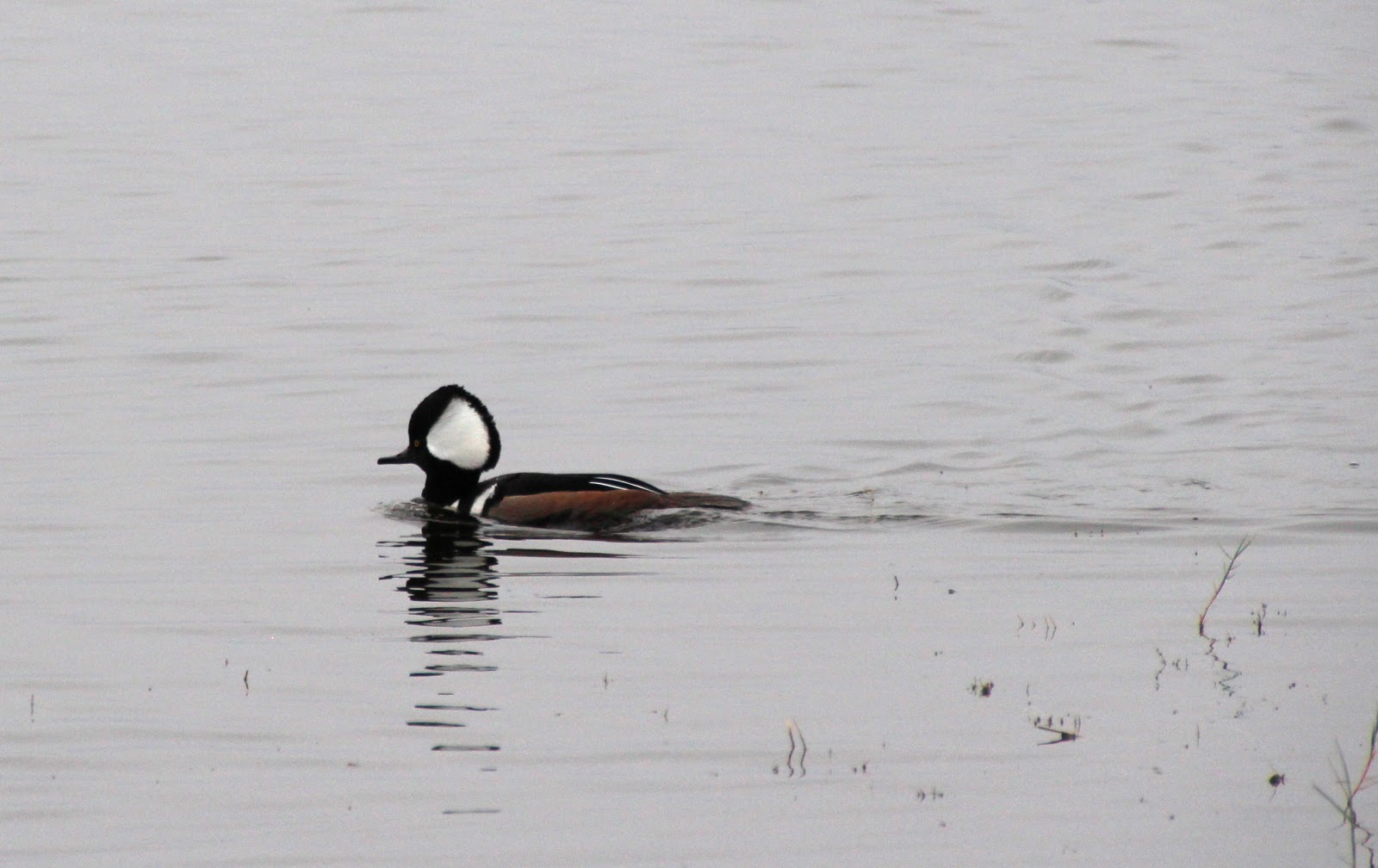
We spotted a large group with a couple of males and lots of females and juveniles. They feed by diving for fish, and are remarkably successful. I love how the males in this video "deflate" their crest before taking a dive!
Probably the most unusual bird at the refuge this winter is the duck with the reddish head in this picture, the Eurasian Wigeon. As its name implies, it is not a native North American bird, although a few appear each year, even sometimes in Ohio. The birds next to it are American Wigeons, which are quite common in Ohio in summer.

Although this is not the prime wildflower time in Florida, there were a few in bloom that added color and interest to the drive. Because of its preference for wet areas and its starchy root, this plant is called Duck Potato (Sagittaria lancifolia).

Another species of wet areas, this plant is known as Pickerel Weed (Pontederia cordata)

In addition to the mangroves, Dahoon Holly (Ilex cassine) lined some of the lagoons and added bright color to the landscape:

No trip through these impoundments and marshes would be complete without spotting an alligator or two!

Needless to say, a winter visit to Merritt Island is well worth the time, for birders and non-birders alike. And here is one final image of that gorgeous wader, the Roseate Spoonbill, coming in for a landing:

More from Florida in future posts!